
Toledo, OH and Northwest Ohio
Deck Staining and Sealing in Toledo, OH
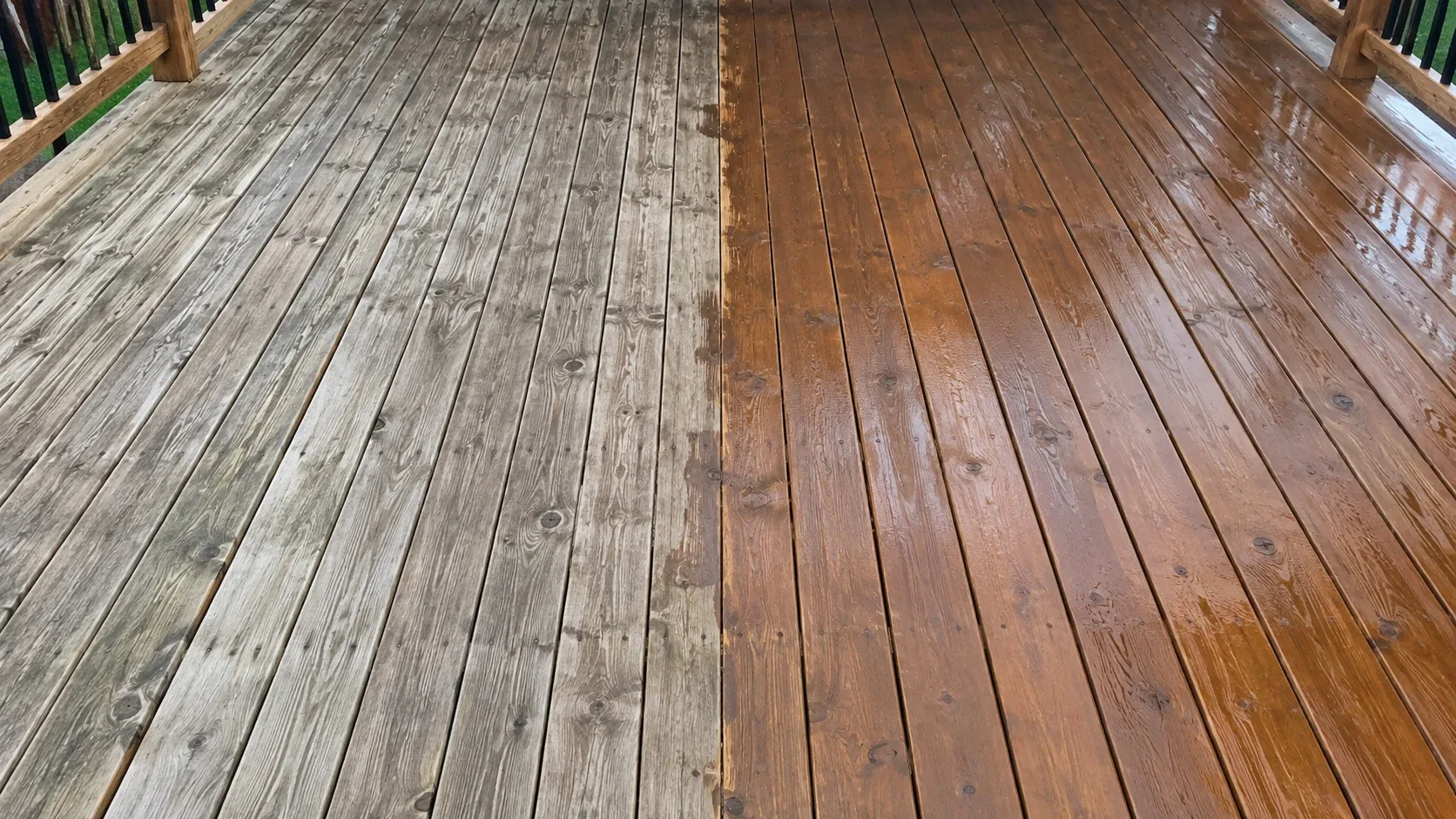
Cleaning, brightening, sanding where the boards actually need it, then a penetrating finish that stands up to an Ohio winter. The least costly way to keep a timber deck alive on this side of the state.
- Footings built for this frost line
- Permits and inspections handled
- Written scope before we start
Toledo Custom Decks cleans, brightens and seals timber decks throughout Toledo and the surrounding communities.
This is the least glamorous service on the whole site and the one that returns the most per dollar spent. Sealing on a two to three year cycle decides whether a deck still looks presentable at twenty years old or needs replacing at eight.
It is also the service homeowners put off longest, because an unsealed deck does not look dramatically worse from one month to the next. The damage accumulates quietly underneath a greying surface until a board that felt sound last summer turns out to be soft this spring, and by then the job has moved from a finishing quote to a repair quote.
What the service actually involves
Inspect first
Before any liquid touches the timber, we note loose boards, fasteners standing proud, soft patches and any movement in the railing. Finishing a board that genuinely needs replacing wastes the effort, and a deck with a structural problem needs repair before it needs a coating of any kind.
Clean
We match the cleaner to the species and to whatever finish is already on the boards, work it in properly, then rinse at low pressure. Cleaning lifts mildew, algae and the grey surface fibres that build up over a season. The water is there to rinse, not to blast the timber apart.
Brighten
An acidic brightener neutralises the cleaner and brings the timber’s pH and colour back into balance before anything else goes on. Skip this step and the finish can dry blotchy, because an alkaline surface will not absorb stain evenly, and nothing applied afterward corrects it once that has happened.
Sand where it is needed
Not every deck requires it. Wherever boards show raised grain, mill glaze or traces of an earlier finish, sanding provides a surface the new coat can actually grip. Railings and handrails get attention here too, since they are the parts people touch directly.
Apply
A penetrating oil based semi transparent stain is our default choice, applied by brush or roller and then back brushed rather than left to sit, so it is properly worked into the grain rather than sitting on top of it.
Two thin coats consistently outperform one heavy coat. A heavy coat that cannot fully soak in leaves a tacky film that never cures correctly, and through a humid stretch that can linger for weeks before it finally sets.
We check the weather forecast before scheduling application day rather than simply working through whatever the calendar says, because a coat applied ahead of rain, or in direct summer heat that flashes it off before it can soak in properly, never performs the way the same product would on a mild dry day.
Cure
Keep furniture and foot traffic off the deck for a day or two, depending on the temperature and humidity at the time. Afterward, set pots on feet rather than flat against the boards, where they trap water underneath and stain the finish around their base.
A deck that gets rugs, planters or a grill dragged back into place the same afternoon it was coated rarely cures evenly, and the soft spots that result are usually the first places the finish fails the following year. Waiting the extra day costs nothing and it protects the whole job.
Choosing a finish
The right product depends less on brand and more on how much sun the deck actually takes, how old the timber already is, and how much colour change you are prepared to accept over the years ahead. We bring samples to the site visit rather than describing colours over the phone, since the same stain reads differently on a board that has already weathered than it does on the sample chip.
Clear sealer
It sheds water and does next to nothing about ultraviolet light, so the deck still greys, only more slowly than left bare. It is the cheapest option and it needs redoing most often. A sensible choice for a covered porch that never receives direct sun in the first place.
Semi transparent stain
Pigment for UV defence while the grain remains genuinely visible underneath. Most decks in this climate get this recommendation, and it offers the best available balance of appearance, protection and time between coats.
Semi solid and solid
More pigment, greater coverage, less visible grain. Useful on an older deck whose boards no longer match one another, or on one that already carries an earlier coating underneath. The thicker the film a product builds, the more likely it eventually is to peel rather than wear away gradually.
What to avoid
Deck paint and heavy film forming products. They look excellent for a season or two and then lift, and removing several hundred square feet of peeled film is the worst job in this trade by a wide margin, both in cost and in how long it takes to finish properly.
Why the Toledo climate matters for scheduling
Freeze thaw and finish life
A humid continental climate with four genuine seasons means real winter cold, repeated freeze and thaw through the shoulder months, and a properly humid summer stretch. Lake Erie moderates the extremes somewhat, though the lake itself often freezes over in winter, which reduces how much moderation actually reaches the deck. Some lake effect snow does reach this side of the lake, though by most accounts meaningfully less than the cities further east of it, given the direction the prevailing wind tends to blow from. Sources vary on the exact seasonal snowfall total, generally putting it somewhere in the range of the high thirties to low forties in inches, but the honest summary is that there is real winter weather here and a real number of freeze thaw cycles for a finish to survive every single year.
None of that is unusual for timber decking generally, but it does mean a finish has to move with the wood through more temperature swings than it would in a milder region, which is exactly what a penetrating oil finish is built to do and a film finish is not. Wood expands and contracts with moisture and temperature at once, and a coating that cannot flex with that movement is the coating that cracks first.
Best season to apply
Spring and autumn generally give the most workable conditions, with temperatures moderate enough for the product to cure properly without flashing off too quickly in direct heat or failing to cure at all in the cold. We avoid coating in the height of summer humidity where possible, and we will not coat timber that has not had time to dry out from a recent rain.
An autumn coat also has the advantage of putting fresh protection down right before the boards face the coldest, wettest stretch of the year, which is exactly when an unprotected deck takes on the most damage. A spring coat instead readies the deck for the season it is actually going to be used, and either timing works as long as the wood is genuinely dry underneath.
How often to recoat
Two to three years on the horizontal surface is the standing rule across this climate, and we would rather see a deck coated a little early than left a season too long, since a finish that has already failed lets the timber start absorbing water again before anyone notices.
What it costs, and why railings change the number
Square footage versus railings
Square footage on the deck surface itself is simple to price. Railings are not. A guard has two faces plus a top and bottom rail, and every baluster presents four separate sides to be coated. A 40 foot run can hold more coatable surface area than the deck floor it surrounds, and it takes considerably longer per square foot because none of it can be rolled the way a flat floor can.
That is the main reason a finishing quote for a deck with heavy timber guards surprises people, and it is one of the stronger arguments for switching to an aluminium railing system, which needs no coating at all, ever.
The strip and refinish situation
Where a previous film finish has already failed and is peeling, the job starts with a chemical strip and a neutralising wash before any new product goes down. That step alone can take longer than the rest of the job combined, which is why a deck in that condition costs more to finish than one that has simply weathered naturally without ever being painted.
Composite decks and staining
None of this applies to capped composite, which should never be stained in the first place and carries its own colour built into the board. Where a composite deck has genuinely faded or looks tired, replacing the boards over the existing frame is the correct next step rather than attempting to coat a material that was never designed to take a finish.
When staining is not the answer
Deeply checked boards, cupped boards, or boards throwing splinters that sanding cannot remove will not be rescued by any finish on the market. Replacing the decking over a sound frame costs more than staining, and it is the correct spend once the timber itself has genuinely reached that state. When we visit, we will tell you plainly which of those two situations applies, and that visit costs nothing either way.
The test is fairly simple in practice. If sanding removes the damage and leaves solid wood behind, staining is the right answer. If sanding removes the damage and leaves a board that is now thinner than it should be, or if the checking runs deeper than the sander can safely go, the board itself needs to come out rather than be coated over.
Where we finish decks
Across Toledo and the surrounding communities, including Sylvania, Ottawa Hills and Perrysburg.
Sylvania, with its mix of established in town lots and newer construction further out, generates a wide range of ages of timber deck, and older boards there often need a full sand and stain rather than a simple wash and reseal. In Ottawa Hills, where many homes date to the 1920s and the architecture is genuinely part of the property’s value, getting the colour and sheen right against a Tudor or Colonial Revival house matters more than it would on a plainer newer build. Perrysburg carries both older homes near the historic downtown and newer construction toward Levis Commons, so the finishing conversation there depends heavily on which part of the suburb the address sits in.
Whichever community the deck sits in, the underlying calendar does not change much. We book finishing work through the spring and again through the autumn, and we would rather schedule a deck a season early than watch it go another winter without protection once the existing coat has clearly given out.
Why homeowners pick Toledo Custom Decks
Footings built for this frost line
Northwest Ohio sits deep enough in the Lake Erie snowbelt that local jurisdictions generally call for footings well past 32 inches, deeper than central or southern Ohio requires. Every post we set lands on a poured footing sized to the depth your jurisdiction sets, which is what keeps a deck level through a decade of freeze and thaw.
Permits and inspections handled
We work out which department your address answers to, whether that is the City of Toledo, a suburb running its own building office, or Lucas or Wood County, pull the permit, meet the inspector and hand you the signed card. An unpermitted deck becomes your problem the day you sell the house.
Written scope before we start
Materials, framing spec, hardware, timeline and price in writing before anybody swings a hammer. No verbal change orders.
Deck Staining and Sealing questions we get asked
How often should a deck be sealed in Toledo?
Every two to three years on the horizontal boards. Railings and vertical faces usually last a little longer because they shed water and take less direct sun. A deck facing south or west generally wants attention sooner than one that sits in shade for most of the day. There is a simple test that costs nothing: drip water onto the boards, and if it soaks straight in rather than beading on the surface, the finish is spent and the timber underneath is taking on water.
Can you seal a brand new deck?
Not straight away. Fresh pressure treated lumber comes out of the treatment process still wet, and coating it before it has dried traps that moisture inside and shortens the life of the finish considerably. We typically wait two to four months, then test with water before applying anything at all. Cedar and kiln dried stock can often be coated sooner than that.
What is the difference between a sealer and a stain?
A clear sealer keeps water out and does very little about ultraviolet light, so the timber still greys over time, only more slowly than if left untreated. A semi transparent stain carries pigment, and pigment is what actually blocks the UV, so the colour holds noticeably longer. A solid colour stain behaves closer to paint and hides the grain almost entirely. In a climate that gets real winter and a genuinely bright summer, a semi transparent product is usually the sensible middle ground.
Why is my deck finish peeling?
Nearly always because a film forming product was applied, or because it went on over a surface that was still damp or dirty underneath. A film sits on top of the timber and cannot move with it through freeze and thaw, so it cracks and lifts away. A penetrating oil finish soaks into the wood and wears away evenly instead of peeling. Removing a failed film is the single most expensive job in this line of work, and it is entirely avoidable with the right product from the outset.
Do you pressure wash the deck?
We clean at low pressure and let the cleaning solution do the actual work rather than the water. High pressure tears open the surface fibres of softwood, which is exactly what leaves a deck feeling fuzzy and shedding splinters afterward. If the boards need more than a wash, they need sanding rather than more pressure, and we will tell you plainly which one applies.
Can you stain a composite deck?
Capped composite should not be stained and does not need it. Older uncapped composite from fifteen or more years back can sometimes be cleaned and coated with a product made for the purpose, though results vary and the coating needs redoing on a shorter cycle than you would expect from timber. Where an old composite deck looks tired, replacing the boards over the existing frame is usually the better spend than trying to coat it.