
Toledo, OH and Northwest Ohio
Deck Lighting in Toledo, OH
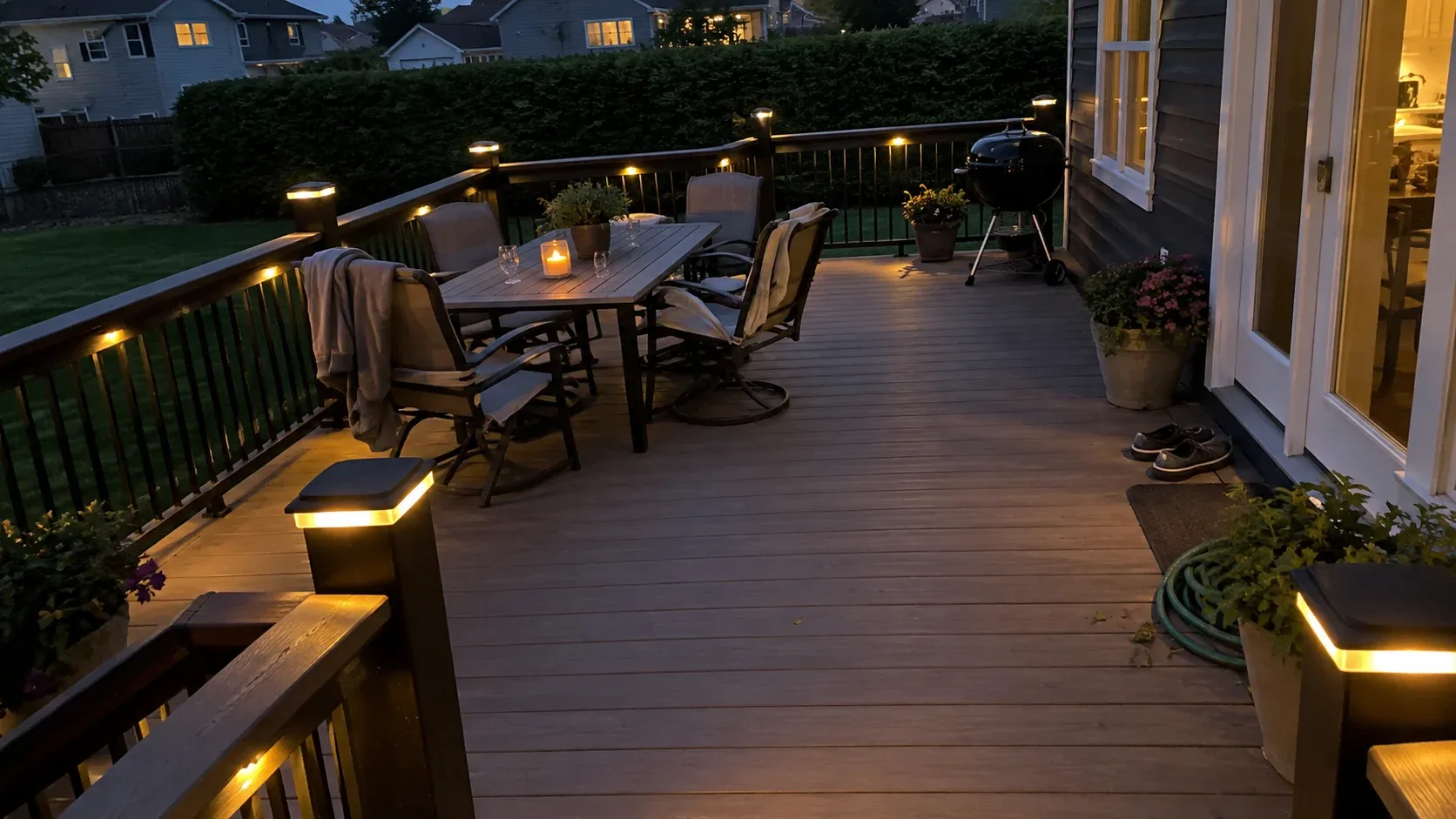
Cable for riser lights, rail strips and post caps is pulled before the frame closes, so once the deck is finished nothing is left on show. The supply is low voltage, dimmable and inexpensive enough to leave running every night.
- Footings built for this frost line
- Permits and inspections handled
- Written scope before we start
Toledo Custom Decks runs deck lighting throughout Toledo and the surrounding communities, from recessed riser lights and under rail strips to lit post caps, and the cable is pulled while the frame is still open.
The spend is a small slice of the overall deck, yet it governs how many evenings the space actually gets used, which is why it earns a place on nearly every estimate we prepare.
A deck that goes dark at sunset effectively closes for the day the moment the light fades, regardless of how well it was built or how much was spent on the decking itself. A deck that stays lit simply carries on being used, which over the life of the structure is worth far more than the modest cost of the wiring that makes it possible. Most of the homeowners who ask us to add lighting later, after the deck is already finished, say the same thing: they wish they had planned for it from the start rather than treating it as an afterthought once the boards were already down.
What actually needs lighting
Stair risers
This is the fixture that matters most and gets discussed least. One recessed light per riser, or every second riser, turns a dark flight into something a guest can actually read at a glance. Safety drives the decision here and the appearance is a genuine bonus on top of it.
On a taller flight descending from an elevated deck toward a lower level, the riser lights stop being an extra and become the reason the lower level actually gets used after dark at all. We generally recommend lighting every second riser as the minimum on a stair with more than four or five steps, and every riser where the run is longer or turns a corner, since a shadowed section partway down a stair defeats the whole point of lighting the rest of it.
The perimeter under the rail
A strip tucked beneath the top rail washes light down over the boards and marks the edge without drawing the eye to any single fixture. Pound for pound it returns more than anything else on this list, because an unbroken line consistently outperforms a handful of isolated points.
The posts
Post caps are the lights you notice from inside the kitchen, so they carry most of the work of making the deck look inviting from indoors after the sun goes down. In truth they illuminate themselves more than the floor around them, and that is precisely the job they are meant to do. A run of evenly spaced post caps along a guard is often the single detail that makes a deck read as finished after dark, in the same way that the decking itself makes it read as finished during the day.
The ceiling, where one exists
Under a covered porch or below an under deck ceiling, recessed ceiling fixtures become the primary light source, and they deserve their own dedicated switch and dimmer separate from the rest of the deck. Because a ceiling fixture runs on line voltage rather than the low voltage system used elsewhere on the deck, it needs an electrician for the final connection, which we coordinate as part of the same project rather than leaving it as a separate call for the homeowner to arrange.
How we install it
Low voltage, transformer at the house
A transformer mounted beside an existing exterior outlet steps the supply down to 12 volts. Every fixture beyond it runs at low voltage, which stays safe when wet and is straightforward to extend later. We choose a transformer with spare capacity built in so later additions do not force a full replacement of the unit, and we position it somewhere accessible for maintenance rather than buried behind decking where a simple bulb swap becomes a project of its own.
Cable run during framing
The cable threads through the posts, along the underside of the top rail and behind the riser boards. Any holes drilled for it are placed where they do not cut into structural members, and the cable itself is secured well away from fasteners. That is the entire argument for deciding on lighting early rather than late in the project, since every one of those paths is straightforward while the frame is open and considerably more awkward once the boards and the skirting are already in place.
Timer or photocell
It switches on at dusk and off at a chosen hour without anyone having to remember to flip a switch. A system operated entirely by hand gets used far less often than one that looks after itself, and across a full season that gap adds up to a great deal of unused evening time.
Zones
On a larger deck it pays to put the stairs on one circuit and the ambient lighting on another. Riser lights are a safety feature first and should be available on their own, without needing to illuminate the entire deck just to light the steps. A separate zone for the posts and rail strip also means the look of the deck can change through the evening, brighter for a dinner early on and dimmed down later without ever touching the stair lighting itself.
Getting the look right
Warm, not white
A warm colour temperature feels like firelight and belongs outdoors. Cool white light turns the space into something closer to a loading bay. That one choice shapes the finished atmosphere more than any other decision on this page, and getting it right costs nothing extra, since it is simply a matter of specifying the correct colour temperature on the fixtures we already planned to install.
Dim sources, and plenty of them
A number of soft light sources beat a handful of harsh ones, and they remove the glare that would otherwise hit anyone seated nearby. Good deck lighting is something you look past rather than something you look directly at. Spreading the same total light output across more, dimmer fixtures rather than fewer bright ones is a small design decision that makes a large difference to how comfortable the deck actually feels once the sun is down.
Leave the yard alone
Floodlights mounted on the house and aimed at the deck ruin the intended effect and tend to annoy the neighbours, which on a tighter suburban lot is a real practical concern rather than merely a courtesy. If security lighting is also wanted, give it a separate circuit and a motion sensor rather than mixing it into the ambient system, so a car pulling into a neighbouring driveway does not flood the deck with light every time it triggers.
Toledo evenings, why lighting extends the season
Long summer evenings near the lake
Summer evenings here run late enough that a well lit deck genuinely gets extra hours of use out of a single day, particularly through the stretch of the year when daylight lingers well past a typical dinner hour. Riser and post lighting simply lets that extra time carry on being usable once the light has actually gone.
The humid continental climate that governs this part of the state also means a genuinely warm, long summer stretch, with Lake Erie moderating the extremes somewhat even though the lake itself often freezes over come winter. Through the warmer months that moderation shows up as pleasant evening temperatures well into the night, which is exactly the window good lighting is built to serve.
Shoulder season use
Spring and autumn bring cooler evenings earlier in the day, and a deck with warm, low level lighting stays inviting through those months in a way an unlit one does not. Pairing lighting with a pergola or a covered porch extends that usable window further still, since shelter from wind and a bit of overhead cover matter as much as light does once the temperature drops.
Adding lighting to an existing deck
What still works after the fact
Post caps, surface mounted rail strips and solar fixtures are all realistic additions to a deck that is already built and finished. None of them need the decking lifted or the frame reopened, which keeps the cost and the disruption modest. A surface mounted strip run along the underside of an existing rail can look nearly identical to one planned in from the start, provided the cable route back to a transformer is straightforward to arrange.
What needs the decking lifted
Recessed riser and floor lights need room behind the board they sit in, which usually means lifting a riser or a run of decking to run the cable properly. We will tell you plainly which options will finish clean on your existing deck and which will leave something visible, and that list is usually shorter than people expect going in. Where a deck is already scheduled for staining or a board replacement, adding lighting to that same visit is almost always cheaper than treating it as a separate project later.
What it costs
Fixture by fixture
Pricing runs per fixture rather than as one flat number, since a small deck with a full stair lighting package can easily cost more than a larger deck with only post caps. We price the actual layout you want rather than a generic package that may not fit the deck in front of us.
The shared transformer
One transformer, timer and length of feeder cable typically serves an entire deck’s worth of fixtures, so that cost is shared across the whole lighting plan rather than charged again for each addition. Sizing it correctly at the outset, with room to grow, is what keeps a later addition simple rather than expensive, and it is the reason we ask what the full plan might eventually include even when the first phase only covers the stairs.
Where we install deck lighting
Across Toledo and the surrounding communities, including Ottawa Hills, Sylvania and Waterville.
In Ottawa Hills, where established homes sit on leafy lots along the Ottawa River, low level lighting that reads as restrained rather than showy suits the architecture far better than anything bright or modern looking. Sylvania’s mix of an in town historic core and newer construction further out means lighting requests range from a simple stair retrofit to a full plan built in from the first day of framing. In Waterville, where the historic village sits close to the river and the old canal route, warm, low key lighting along a deck or a porch fits the character of the place in a way that a harsh, bright system never would.
Wherever the address sits, the same basic plan applies. We pull cable during framing wherever possible, keep the colour temperature warm, and design each layout around the specific deck in front of us rather than a standard package, because a stair beside a wooded lot needs a different plan from an open deck on a level, sunny yard.
Deck cost in Toledo, OH
Estimated installed range
From:$1,600To:$3,400
- Stair riser lights$600–$1,100
- Post cap lights$500–$1,100
- Transformer, timer and wiring$500–$1,200
Consider this a rough planning range rather than a quote. It assumes a standard deck, and a tall structure or difficult access needs a visit before a firm number.
Why homeowners pick Toledo Custom Decks
Footings built for this frost line
Northwest Ohio sits deep enough in the Lake Erie snowbelt that local jurisdictions generally call for footings well past 32 inches, deeper than central or southern Ohio requires. Every post we set lands on a poured footing sized to the depth your jurisdiction sets, which is what keeps a deck level through a decade of freeze and thaw.
Permits and inspections handled
We work out which department your address answers to, whether that is the City of Toledo, a suburb running its own building office, or Lucas or Wood County, pull the permit, meet the inspector and hand you the signed card. An unpermitted deck becomes your problem the day you sell the house.
Written scope before we start
Materials, framing spec, hardware, timeline and price in writing before anybody swings a hammer. No verbal change orders.
Deck Lighting questions we get asked
Is deck lighting worth it?
Any deck with a flight of steps earns back the riser lights on safety alone, since an unlit stair is where a visitor is most likely to be hurt on your property. Beyond that, lighting settles whether the deck goes unused once the sun drops or stays in service through the evening, and those evening hours are a genuine part of what makes a deck worth having in the first place. Lighting is a small slice of the overall budget and it governs how often the rest of the deck actually gets used.
When should lighting be installed?
While the frame is still open, ahead of the decking and the guards going in. Cable travels inside the posts, beneath the rail and behind the riser boards, and once the surface is closed each of those routes becomes awkward and conspicuous to run afterward. A retrofit is achievable, it simply costs more and rarely finishes as cleanly. If lighting is only a possibility on your plan right now, we pull the cable and cap it off, which is inexpensive and keeps the choice open for later.
Is low voltage lighting safe outdoors?
It is, and it is the standard approach on a deck. A transformer at the house steps 120 volts down to 12, and every fixture beyond that point runs at low voltage. It is safe when wet, it avoids the conduit and burial depth requirements that line voltage brings with it, and a failed fixture is cheap to swap out. We size the transformer with spare capacity so additional lights can be added later without needing to replace it.
How much does it cost to run?
Very little. A complete LED system generally uses less power than a single old incandescent lamp. Set on a timer or a photocell it comes on at dusk and switches off at a chosen hour with nobody having to remember, which is also why it genuinely gets used rather than sitting dark most nights. Across a full year the electricity itself is a rounding error beside the price of the fixtures.
Can I put lights under the deck as well?
Yes, and on a deck with an [under deck ceiling](/under-deck-systems) it ranks among the better additions, because the ceiling void gives a route for cable and a surface to recess fixtures into. On a deck with no ceiling, surface mounted low voltage lights fixed to the joists work perfectly well and are simple to add afterward. On a walkout deck the space below is often the reason the whole structure exists, so lighting it turns a covered patio into a room that is usable after dark too.
Will the lights be too bright?
They should not be. Deck lighting exists to reveal edges, steps and faces, not to illuminate the whole garden. We choose a warm colour temperature, low output fixtures and a dimmer where it suits the space. A deck lit like a car park is genuinely worse than one with no lighting at all, and correcting that later is harder because the fixtures are already fixed in place.